Table of Contents (14 sections)
Amazon, Swiggy Instamart and BigBasket Face Major Food-Safety Action in Karnataka
One of India’s biggest online food-safety crackdowns has put three familiar names under the spotlight:
Amazon.
Swiggy Instamart.
BigBasket.
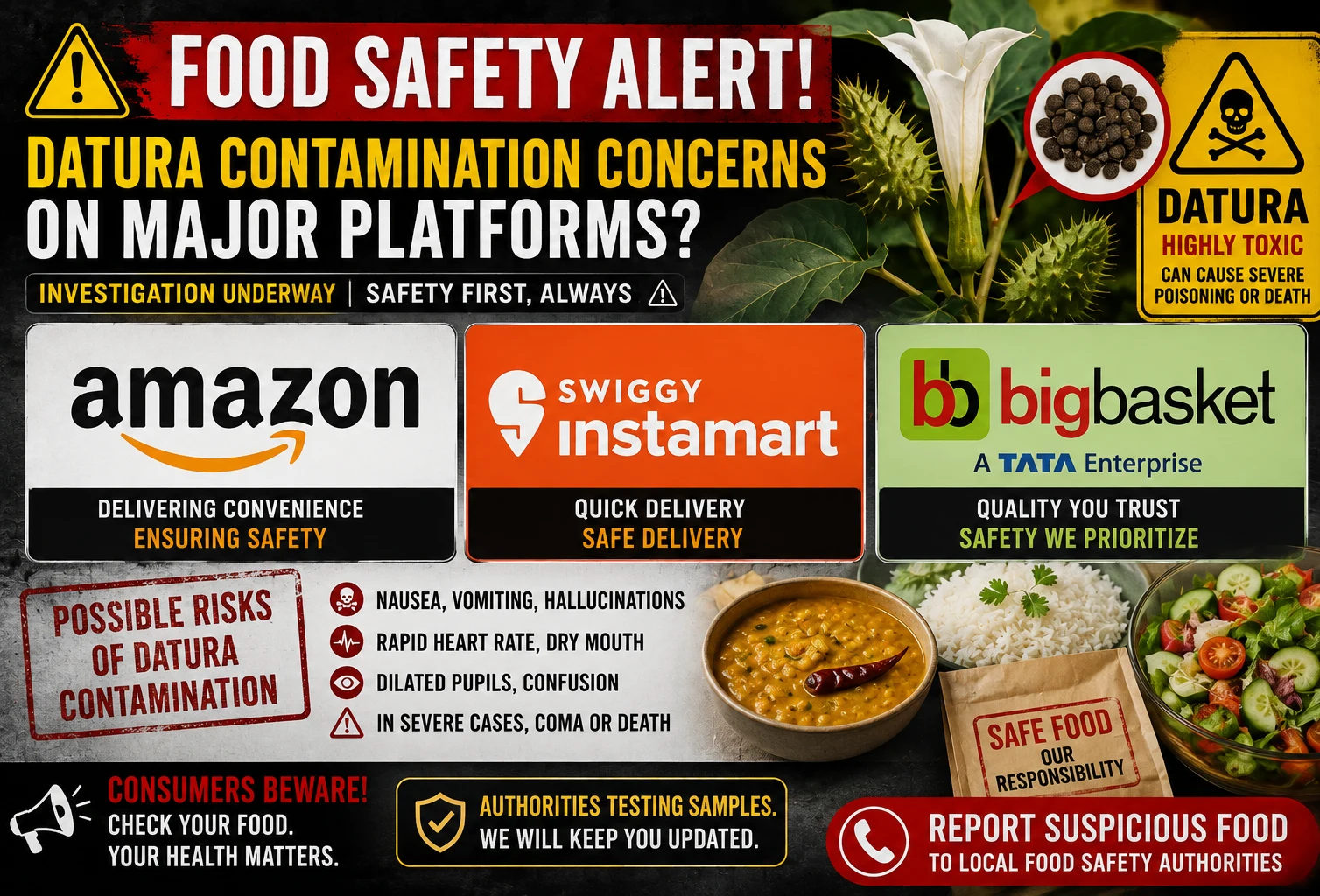
The Karnataka Food Safety and Drugs Administration has ordered the suspension of food licences issued to the three platforms until further orders after an investigation found poisonous Datura (commonly called Dhatura) fruits and seeds being offered online as products for human consumption.
But there’s an important fact consumers need to understand immediately:
The licences have been suspended — not permanently cancelled.
That distinction matters.
The companies have been directed to comply with the food-safety authority’s orders, after which the regulator can consider further action, including whether the suspension should be lifted.
So headlines claiming that Amazon, Swiggy and BigBasket have permanently “lost” their licences should be treated carefully.
What has happened is serious.
But it should also be reported accurately.
What Triggered Such Serious Action?
At the centre of the controversy is Datura.
Datura is a poisonous plant containing naturally occurring toxic compounds.
Its fruits and seeds can pose serious health risks if consumed improperly.
Karnataka food-safety officials investigated after complaints concerning Datura products being offered through online platforms.
What investigators reportedly discovered was alarming.
Datura fruits and seeds were being:
- Displayed online
- Stored in warehouses
- Offered for sale/distribution
- Presented as food or for human consumption
Authorities concluded that such sale and distribution was impermissible.
Some Datura Packets Reportedly Carried FSSAI Numbers
This is perhaps the most disturbing element of the investigation.
According to the Karnataka authority’s findings reported by multiple outlets, some packets containing Datura fruits and seeds carried FSSAI licence or registration numbers.
For an ordinary consumer, seeing an FSSAI number on food packaging can naturally create a sense of legitimacy.
But an FSSAI number should never be interpreted as meaning every product sold by a registered business has automatically been individually approved as safe.
That distinction is extremely important.
The investigation therefore raises a much broader question:
How did a toxic product come to be listed and presented to consumers as food?
That question goes far beyond one product.
It touches the entire online marketplace ecosystem.
What Exactly Has Karnataka Ordered?
The Karnataka Food Safety and Drugs Administration has ordered several immediate measures:
- The food licences associated with Amazon, Swiggy Instamart and BigBasket have been suspended until further orders.
- The platforms have been directed to remove online listings and advertisements offering Datura fruits or seeds for human consumption.
- They have also been directed to stop selling, distributing, displaying or promoting the products as food.
- Licences and registrations associated with suppliers and sellers involved in supplying the Datura products have also faced suspension action.
This indicates that the government is examining the supply chain rather than treating the issue solely as a website-listing mistake.
What Did the Companies Say?
Amazon
According to reports describing the proceedings, representatives from the companies appeared before the authority. In Amazon’s case, the regulatory record cited in current reporting says the company did not submit a response to the notice. The authority subsequently proceeded with its action.
Swiggy Instamart
Swiggy Instamart reportedly sought additional time to submit documents explaining the corrective action it had taken after receiving the notice. The authority did not consider that sufficient reason to avoid immediate regulatory action. Its food licence was therefore included in the suspension order.
BigBasket
BigBasket informed the authority that it had stopped selling the Datura products online. It also reportedly indicated that future labelling would make clear that such products were “Not for human consumption.” However, the regulator considered the explanations before it insufficient and proceeded with the suspension.
Why Is Datura So Dangerous?
This isn’t an argument over an ordinary food-labelling technicality.
Datura can be poisonous. The plant contains toxic substances that can affect the nervous system and other bodily functions.
Reported health consequences of Datura poisoning can include:
- Severe confusion
- Hallucinations
- Abnormal heart rhythms
- High body temperature
- Respiratory complications
- Loss of consciousness
- In severe cases, potentially death
That explains why the Karnataka authority treated listings presenting Datura for human consumption as a public-health issue rather than merely an e-commerce compliance error.
This Raises a Much Bigger Question About Quick Commerce
The incident should not be viewed only as “three companies sold one problematic product.”
There’s a larger issue.
Modern quick-commerce platforms promise astonishing convenience. Open an app. Search. Tap. Pay. Minutes later, groceries arrive.
That model has transformed urban shopping.
But speed introduces an important question:
Who verifies what is being sold before it reaches the consumer?
A marketplace can potentially contain products originating from manufacturers, distributors, third-party sellers, local vendors, importers, warehouse suppliers and other intermediaries.
Consumers don’t see that complicated supply chain.
They see a product image and a “Buy” button.
That means trust becomes extraordinarily important.
A QR Code or Licence Number Cannot Replace Product Verification
This case also provides an important lesson for consumers.
Seeing “FSSAI registered” or an FSSAI licence number does not necessarily mean that FSSAI has personally tested and approved every individual packet listed by a seller.
Food businesses operate under licensing and registration frameworks and are responsible for complying with food-safety requirements.
That is different from interpreting the number as a government guarantee of every product.
Online marketplaces therefore need strong mechanisms for checking:
- What is being listed?
- Who is selling it?
- Is it legally permitted as food?
- Are its claims accurate?
- Does the product category match the licence?
- Has a prohibited or unsafe product slipped into the catalogue?
At the scale at which modern e-commerce operates, these checks become enormously important.
Does This Mean Amazon, Instamart and BigBasket Will Stop Operating in Karnataka?
Consumers should be careful with this interpretation as well.
The order concerns food licences and the regulatory action arising from the Datura investigation.
It should not automatically be interpreted as a blanket statement that every service provided by these companies across Karnataka has permanently shut down.
The accurate headline is:
Karnataka has suspended food licences associated with Amazon, Swiggy Instamart and BigBasket until further orders over the Datura food listings.
Can Their Food Licences Come Back?
Potentially, yes.
The suspension is until further orders, rather than an announced permanent cancellation.
The concerned businesses have been asked to provide compliance reports.
The regulator can consider their responses and compliance before issuing subsequent orders.
That means the next stage matters enormously.
India’s Quick-Commerce Revolution Needs a Food-Safety Revolution Too
Bharat has become one of the world’s most exciting markets for rapid digital commerce.
Groceries can arrive in minutes.
Thousands of products can be searched instantly.
Digital payments happen in seconds.
But convenience cannot move faster than safety.
The faster commerce becomes, the stronger verification needs to become.
Consumers should not have to become food-safety experts before clicking “Add to Cart.”
They need confidence that the systems between the supplier and their doorstep have already performed those checks.
That’s the broader significance of Karnataka’s action.
It sends a strong message:
Digital convenience does not override food-safety law.
Whether a product is sold from a neighbourhood shop or through one of India’s biggest technology platforms, the same fundamental principle must apply:
If it is being sold as food, it must be safe for human consumption and comply with applicable food-safety requirements.
Reality Check
| Claim | Verdict |
|---|---|
| Karnataka permanently cancelled Amazon, Swiggy and BigBasket food licences | ❌ Misleading |
| The action involved Datura/Dhatura products | ✅ True |
| Datura can be poisonous if consumed | ✅ True |
| Products were reportedly offered as food/human consumption | ✅ True |
| Some packets reportedly carried FSSAI licence/registration numbers | ✅ True |
| The platforms are permanently banned from Karnataka | ❌ Not established by the current order |
Reality: The Karnataka Food Safety and Drugs Administration has suspended the relevant food licences until further orders.
Quick Facts
| Topic | Detail |
|---|---|
| Action | Food licences suspended until further orders |
| Platforms | Amazon, Swiggy Instamart, BigBasket |
| Reason | Poisonous Datura fruits/seeds offered as food |
| Authority | Karnataka Food Safety and Drugs Administration |
| Key Concern | Products listed for human consumption |
| Next Step | Compliance reports from companies |

Rajatheertha follows strict editorial standards. If you have corrections, updates or editorial queries, contact our desk.
Submit an Editorial Correction →