Table of Contents (10 sections)
₹18,000 to ₹72,000? A Big Demand Puts 8th Pay Commission Back in Spotlight
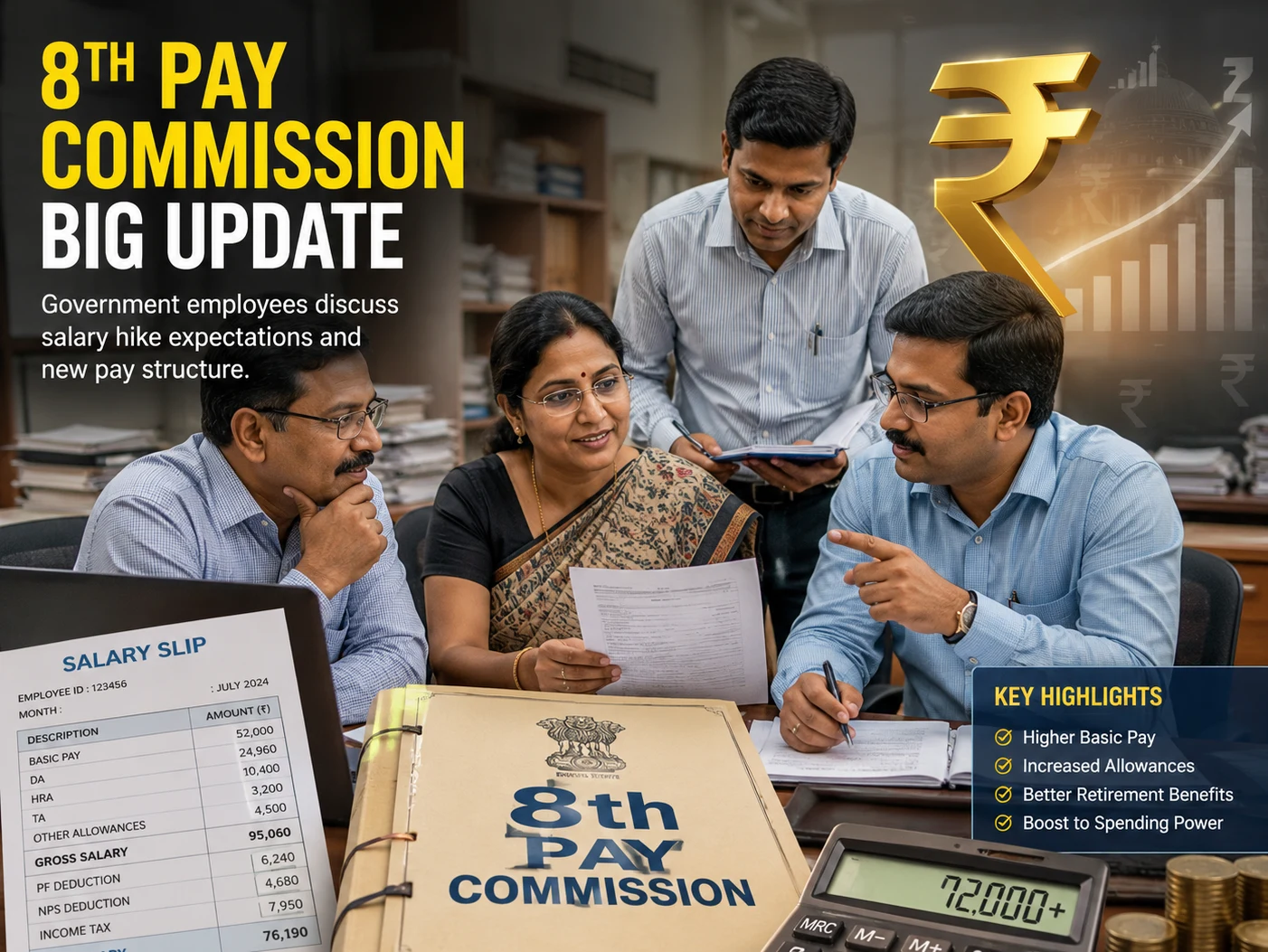
For lakhs of Central Government employees waiting for the 8th Pay Commission, one number is suddenly attracting enormous attention — ₹72,000.
Imagine an employee whose minimum basic pay is currently ₹18,000 per month.
What if that basic pay became ₹72,000?
That’s exactly the kind of increase being sought in a major proposal submitted to the 8th Pay Commission.
But before employees start calculating their new monthly income, there is an important distinction:
₹72,000 has been demanded — it has not been approved by the Central Government.
Here’s what is actually happening.
Who Has Demanded ₹72,000 Minimum Basic Pay?
The Bharatiya Pratiraksha Mazdoor Sangh (BPMS) has submitted proposals concerning the salaries and benefits of Central Government employees.
Among its biggest demands is a minimum basic pay of ₹72,000 per month.
Under the 7th Pay Commission, the minimum basic pay for a Level-1 employee stands at ₹18,000.
BPMS is seeking a fitment factor of 4.0 under the 8th Pay Commission.
The calculation is extremely simple:
₹18,000 × 4.0 = ₹72,000
If such a fitment factor were ultimately accepted, the revised minimum basic pay would therefore work out to ₹72,000.
That’s Four Times the Current Minimum Basic Pay
This is what makes the demand particularly striking.
| Current Minimum Basic Pay | Demanded Fitment Factor | Resulting Basic Pay |
|---|---|---|
| ₹18,000 | 4.0 | ₹72,000 |
In pure numerical terms, that would make the revised basic-pay figure four times the existing ₹18,000 level.
However, employees should not interpret this as meaning their total take-home salary will simply become four times higher.
Basic pay and actual in-hand salary are different.
Why Does the Fitment Factor Matter So Much?
The fitment factor is one of the most important numbers in any Pay Commission discussion because it can be used to determine revised basic pay.
A higher fitment factor can consequently have a major impact on the new pay structure.
For example:
- 2.0 factor: ₹18,000 → ₹36,000
- 2.57 factor: ₹18,000 → ₹46,260
- 2.86 factor: ₹18,000 → ₹51,480
- 3.0 factor: ₹18,000 → ₹54,000
- 3.83 factor: ₹18,000 → about ₹68,940
- 4.0 factor: ₹18,000 → ₹72,000
This is precisely why every discussion about the 8th Pay Commission’s fitment factor is being watched so closely.
Even a relatively small difference in the final multiplier can translate into thousands of rupees in revised basic pay.
BPMS Wants More Than a ₹72,000 Minimum
The proposal isn’t limited to the minimum salary.
Among the reported demands from BPMS is an increase in the annual increment from the existing 3% to 6%.
That could become particularly significant over a long government career because annual increments influence how basic pay grows over time.
The employee body has also raised other proposals concerning the structure used for determining minimum wages.
But Has the Government Approved ₹72,000?
No.
This is the most important point for employees reading headlines about the ₹72,000 figure.
At present:
- ₹72,000 = Employee body’s demand
It does not mean:
- ₹72,000 = Final Government-approved minimum basic pay
Different employee organisations have put forward different demands and calculations.
The 8th Pay Commission must examine representations from employees, pensioners, unions and other stakeholders before making its recommendations.
Therefore, headlines saying that the minimum salary “will become ₹72,000” are premature.
A more accurate statement is that there is a demand to increase the minimum basic pay to ₹72,000.
8th Pay Commission Process Is Moving Forward
The 8th Central Pay Commission has already become one of the most closely watched financial developments for government employees and pensioners.
The Union Cabinet approved the Commission’s Terms of Reference in October 2025.
The government stated at the time that, based on the usual ten-year interval between Pay Commissions, the effect of the 8th Central Pay Commission recommendations would normally be expected from January 1, 2026.
The Commission is examining matters related to salaries, allowances, pensions and other benefits.
That does not mean every demand submitted by an employee organisation will be accepted.
The final recommendations — and ultimately the government’s decisions on them — are what will determine the actual financial benefit.
Why Employees Are Watching Every Update
For a Central Government employee, a Pay Commission is much bigger than one salary number.
Changes in basic pay can influence the broader compensation structure, while pensioners are also closely watching how the eventual recommendations could affect retirement benefits.
That’s why speculation surrounding figures such as ₹50,000, ₹69,000 and now ₹72,000 attracts immediate attention.
But until the final recommendations and government decisions arrive, these figures should be treated as proposals or estimates depending on the source — not guaranteed salaries.
The Big Question: Will ₹72,000 Become Reality?
For now, there is no confirmed answer.
A 4.0 fitment factor would represent a very substantial revision. The Pay Commission will have to consider employee expectations alongside economic conditions and the financial implications for the government.
The ₹72,000 demand has nevertheless set a powerful benchmark in the ongoing discussion.
For an employee currently looking at a minimum basic pay of ₹18,000, the possibility of a substantially higher figure naturally generates excitement.
But the safest approach is simple:
Watch the official recommendations, not just viral salary figures.
The demand is ₹72,000.
Whether it becomes reality will depend on what the 8th Pay Commission recommends and what the Central Government ultimately accepts.
Quick Facts
| Topic | Detail |
|---|---|
| Current Level-1 Minimum Basic Pay | ₹18,000 |
| Minimum Basic Pay Demanded by BPMS | ₹72,000 |
| Fitment Factor Demanded | 4.0 |
| Calculation | ₹18,000 × 4 = ₹72,000 |
| ₹72,000 Approved? | No |
| 8th Pay Commission Status | Recommendations under consideration / process |

Rajatheertha follows strict editorial standards. If you have corrections, updates or editorial queries, contact our desk.
Submit an Editorial Correction →